


Preimplantation Development
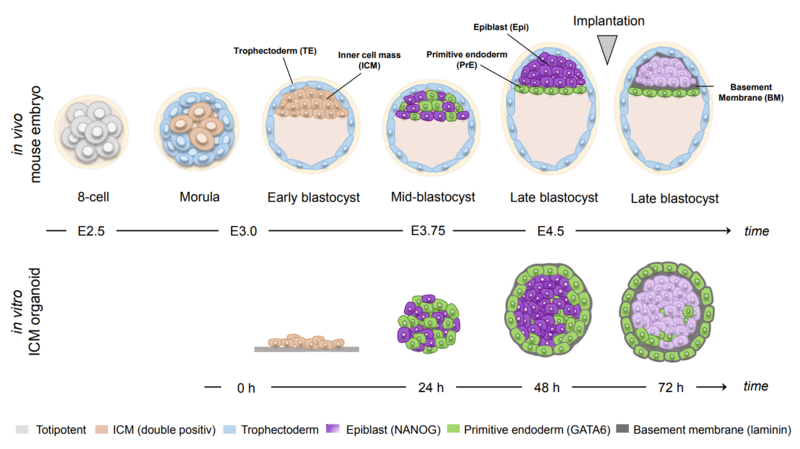
The first days after fertilization are a key period of development. A single fertilized cell undergoes a series of cell divisions and progressively gives rise to different cell populations. The cells of the epiblast will form the embryo itself, while the cells of the primitive endoderm contribute to extraembryonic tissues that support its development, such as the placenta and the yolk sac.
This stage is also particularly vulnerable, as 70% of mammalian embryos fail before implantation. Understanding why some embryos develop successfully while others do not therefore requires us to understand the mechanisms that control cell fate decisions and organization during these first days.
In this project, we investigate how cells communicate, make cell fate decisions, and organize themselves during preimplantation development. We use the mouse embryo as a model system and combine computational modeling, deep learning approaches, and experimental data to uncover the mechanisms driving this complex process.




Agent-Based Modeling
To understand how the behavior of individual cells can give rise to the organization of an entire embryo, we use agent-based modeling. In this approach, every cell is represented as an individual computational agent with its own properties and behaviors. By simulating many interacting cells, we can study how complex structures emerge from simple local interactions.
Our model captures several key processes:
- Cell growth: Acquiring nutrients allows cells to grow, effectively increasing their radii.
- Cell division: Once a cell reaches a certain size, it can divide into two daughter cells.
- Physical interactions: A combination of adhesive and repulsive forces holds the cells together.
- Intercellular commnication: The combination of chemotactic processes and a gene regulatory network regulates cell fate decision and cell movement.
The description of individual cells and their interactions allow us to recreate the complex biological processes during preimplantation development. By explicitly modeling these interactions, we can recreate aspects of preimplantation development in silico and investigate which mechanisms are essential for the correct pattern formation of the developing embryo.
This gives us a powerful tool to test biological hypotheses computationally. Instead of relying on expensive, time-intensive, and methodologically restrictive experimental approaches, we have fine control over the mechanisms at play and test many possible scenarios. In this way, computational modeling complements experimental work and helps uncover the fundamental mechanisms underlying early development.

Simulation-Based Inference
Building the simulation model is only the first step. To understand real biological systems, we need to determine which mechanisms and parameter values allow our model to reproduce what we observe in vitro.
In conventional simulation, we specify the properties of the system and observe what behaviors emerge. In simulation-based inference, we approach the problem from the other direction: Given what we observe in experimental data, what can we infer about the underlying biological mechanisms?
Using simulation-based inference, a deep learning approach, we can learn the relationship between the mechanisms and parameters of our agent-based model and the observable traits of the emerging embryo. Combining this with experimental data from our collaborator, Dr. S. Muñoz-Descalzo (ULPGC, Gran Canaria, Spain), we can calibrate our model to closely reproduce the behavior of a real embryo and discover which mechanisms are required to explain experimental observations.
This combination between biology, mathematical modeling, and machine learning allows us to move beyond simply simulating development and infer which biochemical and biophysical mechanisms drive cell fate decision and tissue organization.