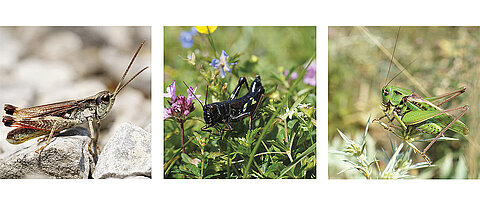



Insect diversity is declining in Bavaria. Land use is a major driver, but the impact of climate change is still unknown. A study by the University of Würzburg has now investigated how both factors interact.
more
Insect diversity is declining in Bavaria. Land use is a major driver, but the impact of climate change is still unknown. A study by the University of Würzburg has now investigated how both factors interact.
more
Do pesticides have anything to do with the decline in bee populations? A research team led by the University of Würzburg has investigated - and found a connection between fenbuconazole and the insects' mating behavior.
more
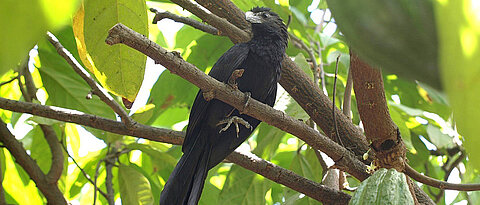
The tropical tree, from whose seeds chocolate and other sweets are produced, has its secrets. Unravelling them is not so easy.
more
In northern Spain, wild honeybees use hollow electricity poles as nesting cavities. Natural areas in the surroundings promote the colonies’ chances to survive the winter.
more
The question of the causes of species extinction confronts science with complex tasks. Dr Sarah Redlich from the Biocentre on the challenge of creating a study design.
more
Urbanisation appears to be another key factor for insect decline. This is shown by a study in which the impact of climate and land use on insects was disentangled for the first time.
more
The higher the biological diversity in an ecosystem, the better the important processes there function. A heterogeneous environment promotes this effect, while intensive land use weakens it, as a new study shows.
more
The newly funded EU Horizon 2020 project Safeguard will address the decline of wild pollinators, its effects on biodiversity and ecosystem services, and options to restore pollinator diversity.
more
The time deadwood in forests needs to decompose depends on climate as well as on fungi and insects. Researchers have now quantified the contribution of deadwood to the global carbon cycle.
more
In an exceptionally broad and elaborate study, biologists from the University of Würzburg investigated the biodiversity of flowering fields planted as part of agri-environmental schemes.
more
Please do not disturb: After forest fires, bark beetle infestations and other damage, the affected forests should not be cleared. Researchers report this in the journal Nature Communications.
more
An oak forest in Lower Franconia has caused a small sensation in zoology: A moth was discovered there that was considered extinct.
more
Honeybees use their waggle dance to tell their conspecifics where to find food. Depending on the honeybee species, there are different dance dialects, as a German-Indian research team has shown.
more
Dead wood plays an important role for biodiversity in forests. The Ecological Station of the University of Würzburg and the Forest Enterprise Ebrach conduct a joint research project on this topic that has been recently granted with 500,000 euros.
more
The forests in Europe provide habitat for around 80,000 colonies of wild honeybees. That is why more attention should be paid to preserving the nesting sites for these threatened insects, according to researchers.
more