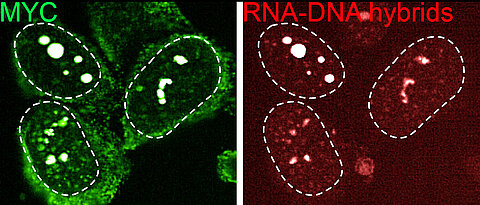
The cancer gene MYC camouflages tumours by suppressing alarm signals that normally activate the immune system. This finding from a new study offers a promising way to improve existing cancer therapies as well as develop new ones.
more



The cancer gene MYC camouflages tumours by suppressing alarm signals that normally activate the immune system. This finding from a new study offers a promising way to improve existing cancer therapies as well as develop new ones.
more
According to a new study by the University of Würzburg, Bavarian meadows are the most monotonous insect habitats. Surprisingly, fields and settlements often offer more diversity than grassland.
more
Climate change and biodiversity loss are among the most pressing challenges of our time. With Trees4Adapt, the European Union has launched a project to address these challenges – with the University of Würzburg as a partner.
more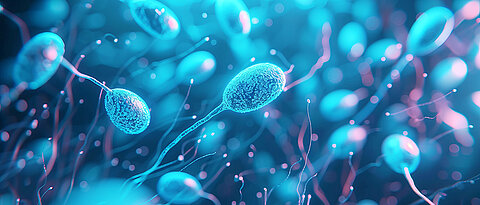
A functional sperm tail is essential for successful reproduction. Defects in its development often lead to infertility. This is also shown by a recent international study involving researchers from Würzburg.
more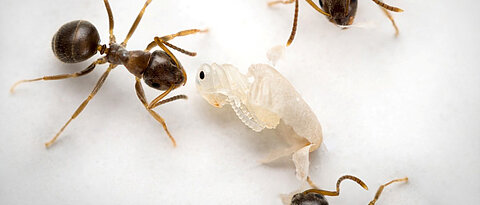
When ant pupae are infected by pathogens, they change their body odour. In this way, they warn the colony of the risk of infection - and thus seal their death.
more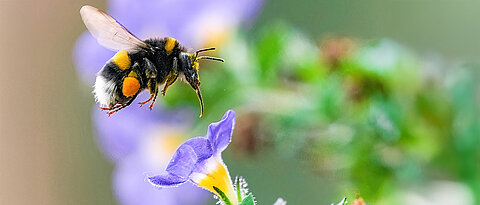
Glossy flowers are visible to bees from a distance, but make color recognition difficult up close. They thus represent a visual compromise of nature, as a new study by the University of Würzburg shows.
more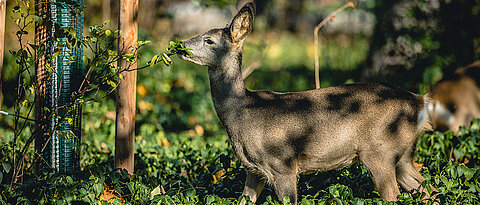
Even in sunny forest gaps, browsing by roe deer prevents the natural regeneration of many tree species. Researchers at the University of Würzburg show just how strongly these ungulates shape forest development.
more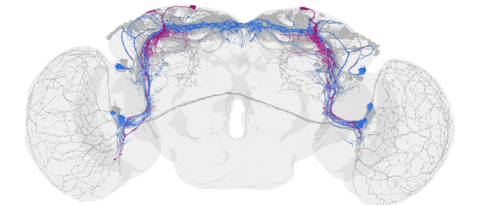
A tiny neural network is sufficient to control the daily rhythm of the fruit fly, Drosophila melanogaster. Researchers at the University of Würzburg have shown that only four specialized nerve cells are necessary to drive the animals' endogenous clock.
more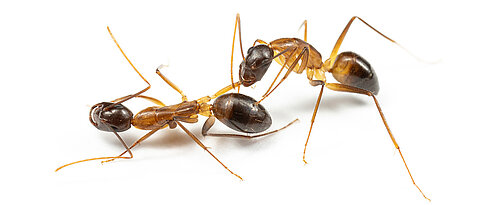
Carpenter ants are not squeamish when it comes to caring for the wounded. To minimise the risk of infection, the insects immediately amputate injured legs – thereby more than doubling their survival rate.
more
Healthy growth of wheat, maize and other crops is not possible without the plant's own hormones. Professor Ulrich Hammes is investigating the proteins that help the hormones reach their sites of action.
more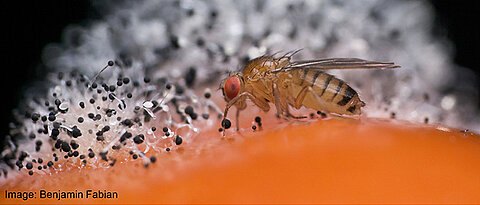
Fruit flies in the home? Professor Silke Sachse from the Biocentre, an expert on these insects, has some simple tips.
more
Dr. Mariana Prokopuk studies invasive aquatic plant species and their adaptation to new habitats. She is currently at the University of Würzburg on a Coimbra Group scholarship.
more
Walks around the Würzburg Hubland campus with University Chancellor Uwe Klug, with the "Living Campus" initiative or with students in the campus garden: A total of 20 new short films deal with sustainability at the university.
more
Improving biodiversity and maintaining yields at the same time? For many, this sounds like a contradiction in terms. However, a new study by the University of Würzburg shows that both are possible under the right conditions.
more
It is highly likely that the female menstrual cycle was originally synchronized with the lunar cycle. This has changed significantly with the rise of artificial light and smartphones, as a new study by the University of Würzburg shows.
more