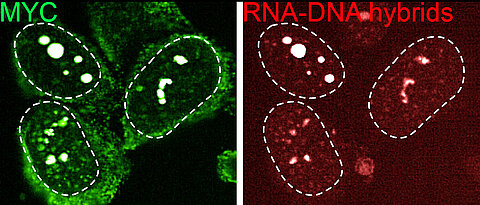
The cancer gene MYC camouflages tumours by suppressing alarm signals that normally activate the immune system. This finding from a new study offers a promising way to improve existing cancer therapies as well as develop new ones.
more




The cancer gene MYC camouflages tumours by suppressing alarm signals that normally activate the immune system. This finding from a new study offers a promising way to improve existing cancer therapies as well as develop new ones.
more
According to a new study by the University of Würzburg, Bavarian meadows are the most monotonous insect habitats. Surprisingly, fields and settlements often offer more diversity than grassland.
more
Climate change and biodiversity loss are among the most pressing challenges of our time. With Trees4Adapt, the European Union has launched a project to address these challenges – with the University of Würzburg as a partner.
more