

Deutsch
THE BIOCENTER OF THE UNIVERSITY OF WÜRZBURG

Archive

Taking Insects on a Virtual Journey

12/04/2023
Hannah Haberkern studied biomedicine at the University of Würzburg. After 14 years abroad, she has now returned to JMU.

How do flies and ants find their way? Neuroscientist Hannah Haberkern is investigating this question with a new Emmy Noether independent junior research group. To do this, she has moved from the USA to Würzburg.

more

Communicating Soil Biodiversity to Kids Around the Globe

12/01/2023
none

Inspiring children around the globe to learn about soil diversity - that is the aim of an initiative launched by Malte Jochum, an ecologist at the University of Würzburg.

more

Broad Bean Thrives Despite a Hyperactive Ion Channel

11/24/2023
none

Plants in which an ion channel of the vacuole is hyperactive are extremely stressed and grow poorly. But the broad bean is an exception, as Würzburg researchers have discovered.

more

How A Pitcher Plant Evolved with Tenfold Genomic Wealth

11/23/2023
Pitcher plants like Nephentes gracilis use their specialized leaves to capture insects. This food supplement allows the plants to thrive even in nutrient-poor habitats.

A new study by Würzburg botanist Kenji Fukushima shows the role of subgenome dominance for plants in the evolutionary development of special traits, such as a carnivorous lifestyle.

more

Highly Cited Researchers 2023

11/15/2023
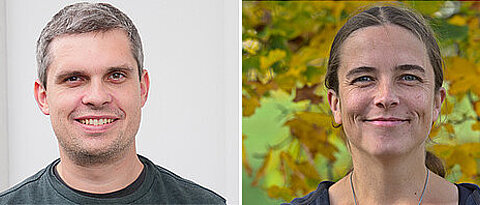
Highly Cited: Dominic Grün, Christoph Wanner, Rainer Hedrich, José Pedro Friedmann Angeli. and Hermann Einsele.

Their work is most frequently cited in publications of other scientists. Researchers from the University of Würzburg are therefore included in the Highly Cited Researchers 2023 list.

more

A Potential Target for New Anti-Cancer Agents

11/07/2023
Brains of three-day-old adult flies. Left: Healthy specimens. Center: animals with a brain tumor. Right: Brain tumor after reduction of SPT5 levels. Green coloring shows central brain regions. Red coloring shows the cerebral cortex, which is strongly expanded by the tumor.

MYC proteins play an important role in many types of cancer. A research team at the University of Würzburg has now succeeded in indirectly influencing these proteins - with clear consequences for the tumor.

more

AI Models Identify Biodiversity in Tropical Rainforests

10/17/2023
none

Animal sounds are a very good indicator of biodiversity in tropical reforestation areas. Researchers led by Würzburg Professor Jörg Müller demonstrate this by using sound recordings and AI models.

more

Important Additional Driver of Insect Decline Identified

09/27/2023
none

Combinations of unfavourable weather conditions over several years can cause a decline in insect biomass. This is shown by a study published in "Nature" by a team led by Professor Jörg Müller.

more

Lecture by Katalin Karikó at the Biocenter Colloquium

09/27/2023

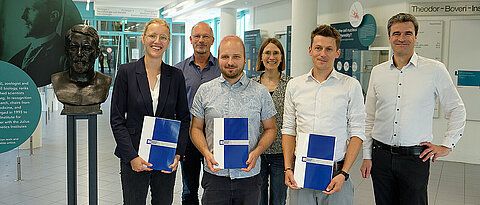
On July 26, 2023, Katalin Karikó was awarded the Theodor Boveri Prize by the Würzburg Physical-Medical Society. Those who could not experience her inspiring lecture in person at the Biocenter can watch the recording here.

more

Optimized cacao pollination for higher yields

09/13/2023
For a cacao plant to bear such rich fruit, it needs effective pollination. A research group, in which JMU was involved, has investigated how this can best be achieved.

How can the cultivation of cacao be improved by using the right pollination technique? This has now been investigated by a research team including Ingolf Steffan-Dewenter's Department of Animal Ecology and Tropical Biology.

more

How internal clocks control fat metabolism

09/11/2023
In the fruit fly Drosophila, a central circadian clock in the brain controls important parameters such as daily activity or food intake. Peripheral clocks receive timing signals via further pathways, and act as clocks for various metabolic processes. If the clocks chronically get out of sync, this can trigger diseases.

In the fruit fly Drosophila, circadian clocks also control fat metabolism. This is shown in a new study by a research team at the University of Würzburg. The findings could also be relevant for humans.

more

DNA Chips as Storage Media of the Future

08/24/2023
Information can be stored in the form of DNA on chips made of semiconducting nanocellulose. Light-controlled proteins read the information.

In the form of DNA, nature shows how data can be stored in a space-saving and long-term manner. Würzburg's chair of bioinformatics is developing DNA chips for computer technology.

more

Heat Sensor Protects the Venus Flytrap From Fire

08/22/2023
The Venus flytrap has a heat sensor in its sensory hairs, through which it reacts to heat waves in the run-up to bushfires. If the temperature rapidly exceeds the 37 degree Celsius mark, a calcium-dependent action potential (AP) is fired as a warning signal. If the temperature rises to the threshold of 55 degrees Celsius, a second AP is fired, the trap closes and the sensory hairs are protected from burning.

The sensory hairs of the Venus flytrap contain a heat sensor that warns the plant of bush fires. It reacts to rapid temperature jumps, as Würzburg researchers have discovered.

more

The woman behind the vaccine breakthrough

07/11/2023
Die Forscherin Katalin Karikó kommt an die Universität Würzburg.

With her research, biochemist Katalin Karikó has laid the foundation for the development of RNA vaccines against the coronavirus. Now she is coming to the University of Würzburg to give a public lecture.

more

With head and leg to the beautiful cut

07/07/2023
A typical behaviour: When the leafcutter ant Atta sexdens cuts pieces of leaves, it holds onto the leaf edge with its hind legs to determine the size of the cut.

How do leafcutter ants measure the size of the leaf pieces they cut off? A study by the University of Würzburg now provides answers.

more