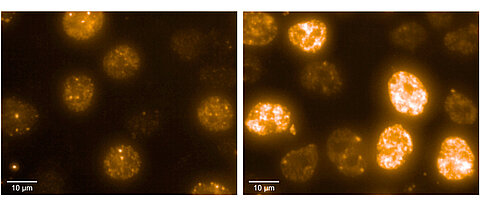



The smallest cell structures can now be imaged even better: The combination of two microscopy methods makes fluorescence imaging with molecular resolution possible for the first time.
more
The smallest cell structures can now be imaged even better: The combination of two microscopy methods makes fluorescence imaging with molecular resolution possible for the first time.
more
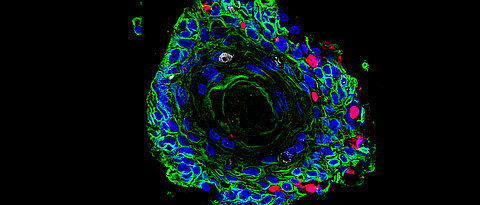
New details are known about an important cell structure: For the first time, two Würzburg research groups have been able to map the synaptonemal complex three-dimensionally with a resolution of 20 to 30 nanometres.
more
Using a new approach, scientists are applying the techniques of physics to investigate the relationships between parasites and their hosts. The programme is led by the Würzburg cell biologist Markus Engstler.
more
Environmental pollution is responsible for matings between two fish species that usually don't mix. In their offspring, scientists have now identified genes relevant for the development of skin cancer.
more
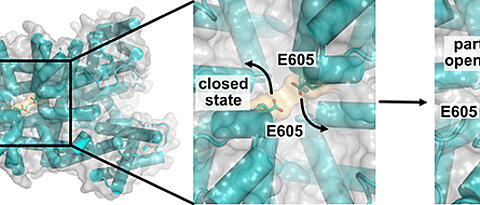
"Distance keeping" is not exactly the motto of the glutamate receptors: Using high-resolution microscopy, it now was discovered that the receptors usually appear in small groups at the synapses and are in contact with other proteins.
more
Message to all students from the university management
more
For the first time, the cells of fungi can also be analysed using a relatively simple microscopic method. Researchers from Würzburg and Cordoba present the innovation in the journal "Frontiers in Microbiology".
more
Sturgeons lived on earth already 300 million years ago and yet their external appearance seems to have undergone very little change. A team of researchers from Würzburg and Berlin has now succeeded in sequencing their genome.
more
In squamous cell carcinoma, a protein ensures that unneeded proteins are no longer disposed of. A research team at the University of Würzburg has switched off this protein for the first time.
more
How do insects see the world? This is what Dr. Anna Stöckl wants to know. Her research program has now been awarded a distinction: she has been accepted into the Young Academy of the Bavarian Academy of Sciences and Humanities.
more
Honeybees use their waggle dance to tell their conspecifics where to find food. Depending on the honeybee species, there are different dance dialects, as a German-Indian research team has shown.
more
Many bacterial pathogens develop resistance to antibiotics. In their search for new therapeutic strategies, Würzburg research groups employ modern digital technologies. The Free State of Bavaria provides millions for this purpose.
more
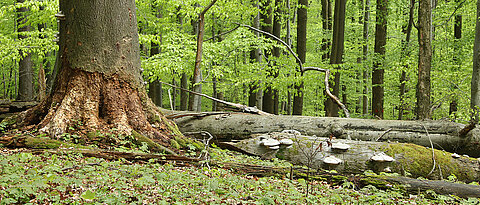
Dead wood plays an important role for biodiversity in forests. The Ecological Station of the University of Würzburg and the Forest Enterprise Ebrach conduct a joint research project on this topic that has been recently granted with 500,000 euros.
more
Dwarfism and other developmental disorders are the consequences of a specific genetic defect. Researchers at the universities of Würzburg and Regensburg have now examined this gene in more detail.
more
New technologies are needed to combat climate change. Now bioinformatics specialists from Würzburg might have found a way of enabling plants to store more carbon dioxide.
more