




Deutsch
THE BIOCENTER OF THE UNIVERSITY OF WÜRZBURG

Archive

Cool adaptations to the cold

02/25/2019
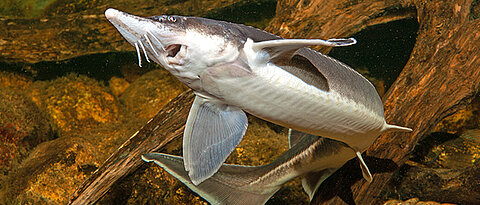
Icefish under water

Icefish live in an environment that should be deadly for them. Scientists have now investigated how they still manage to exist there and what evolutionary adaptations they have had to undergo in order to do so.

more

How plants learned to save water

02/21/2019
Two open stomatal pores on the surface of a fern leaf, each surrounded by two kidney-shaped guard cells. Right panel: important moments during the evolution of stomata. Stomata probably evolved in an early land plant, from which all today’s species descend, but were likely lost in liverworts. Some genes that control stomatal movement in flowering plants likely arose recently, in seed plants, from within ancient gene families that were present in algae. Signalling genes with specific roles in guard cells likely arose after mosses diverged from a common ancestor.

Plants that can manage with less water could make agriculture more sustainable. This is why a research team at the University of Würzburg is investigating how plants control their water balance.

more

Alexander von Humboldt Research Fellow at the Ecological Station Fabrikschleichach

01/17/2019
Photo: Dr. Alexandro B. Leverkus

Dr. Alexandro B. Leverkus, Universidad de Alcala (Madrid), is an Alexander von Humboldt Research Fellow at the Ecological Station Fabrikschleichach of the Biocenter (Zoology III) from 01.01.2019 to 31.12.2020. Leverkus is currently researching the topic "Forest disturbances in the Anthropocene: Unravelling ecological interactions between wildfire and (salvage) logging".

more

The Algae’s Third Eye

01/11/2019
In this multicellular Volvox alga, the novel light sensor 2c-cyclop was labeled with fluorescence (green). It shows up in membranes around the nucleus. (Image: Eva Laura von der Heyde)

Scientists at the Universities of Würzburg and Bielefeld in Germany have discovered an unusual new light sensor in green algae. The sensor triggers a reaction that is similar to one in the human eye.

more

Longer siesta on bright days

01/08/2019
Fruit Fly

Insects and mammals have special sensors for different light intensities. These sensors selectively influence the circadian clocks and thereby control daily activity patterns.

more

Progress in Super-Resolution Microscopy

12/17/2018
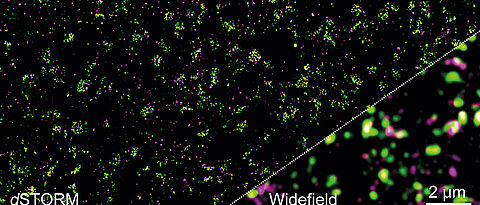
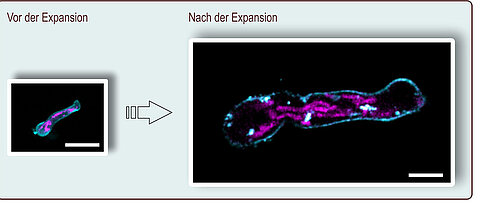
Microscopy of centrioles.

Does expansion microscopy deliver true-to-life images of cellular structures? That was not sure yet. A new publication in "Nature Methods" shows for the first time that the method actually works reliably.

more

News About a Plant Hormone

12/07/2018
3d-Model of the guard cell potassium ion channel GORK

The plant hormone jasmonic acid also performs a function that was previously unknown. It ensures that the leaf pores close when leaves are injured. For the plant, this could be an emergency signal.

more

Molecular insights into spider silk

12/06/2018
Schematic scheme of a spidroin

Spider silk belongs to the toughest fibres in nature and has astounding properties. Scientists from the University of Würzburg discovered new molecular details of self-assembly of a spider silk fibre protein.

more

New Professor at CCTB

12/06/2018
Picture: Sabine Fischer

Since October 2018, Sabine Fischer heads the research group for Supramolecular and Cellular Simulations at the Center for Computational and Theoretical Biology (CCTB). Now she will introduce herself with a lecture titled “Auf gute Nachbarschaft!/To being good neighbours! Mathematical biology of intercellular interactions in developing tissues”.

more

A one-way street for salt

09/20/2018
Quinoa stores salt in the bladder cells on its leaves. (Picture: Jennifer Böhm)

Barely heard of a couple of years ago, quinoa today is common on European supermarket shelves. The hardy plant thrives even in saline soils. Researchers from the University of Würzburg have now determined how the plant gets rid of the excess salt.

more

New insight into the metabolic interactions in tumours

08/30/2018

It has been known for a long time that cancer cells change their metabolic activity. However, the full complexity of metabolic reprogramming in cancer cells and the metabolic cross-talk between cancer cells and their surrounding environment has only recently been fully appreciated.

more

The Evolution of Carnivorous Plants

08/30/2018
Kenji Fukushima. (Photo: private)

The evolution biologist Dr. Kenji Fukushima is awarded a prize money of about 1.6 million euros by the Alexander von Humboldt Foundation. He will use the money to build up a new working group at the University of Würzburg.

more

Well Placed in the Shanghai Ranking

08/22/2018
JMU's main building. (Photo: Robert Emmerich)

The prestigious Shanghai Ranking has placed the University of Würzburg among the world’s top 200 universities – as one of three Bavarian and 14 German universities.

more

Algae Have Land Genes

07/12/2018
quer: Die Alge Chara nutzt elektrische Potentiale, um in ihrem Körper Signale über längere Strecken (mehrere Zentimeter) weiterzuleiten. Welche Ionenkanäle daran beteiligt sind, ist noch unbekannt. Bild um 90 Grad gekippt. (Bild: Nora Stingl, Rob Roelfsema, Anna Alova)

The genome of the algae species Chara braunii has been decoded. It already contains the first genetic characteristics that enabled the water plants' evolutionary transition to land.

more

Ten million euros for cancer research

07/04/2018
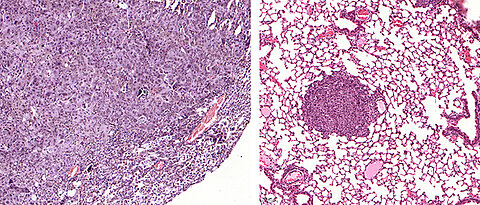
The German Cancer Aid will establish a junior research center in Würzburg to do cancer research (the picture shows a carcinoma of the prostate, yellow). (Photo: Würzburg University Hospital)

The German Cancer Aid will set up one of five Mildred Scheel Junior Research Centers in Würzburg. The center aims to provide ideal working conditions for young cancer researchers.

more